Archive for Mark BjellandPage 3
The Distinctive Look of a City
A fascinating article in Atlantic Cities explains how data mining of Google Street View images can identify the distinctive visual elements of a city. For Paris the computer identified the distinctive elements as street signs, ornate 19th Century windows, cast iron balconies, and decorative street lamps. You can’t see the rooflines on a Google Street […]
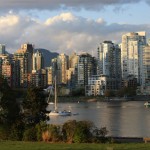
The Visual Image of a City
Thomas Sigler, a former visiting assistant professor of geography at Gustavus, has authored a fun piece in Atlantic Cities entitled, “What Your Skyline Says About Your City.” Thomas points out the difference in skylines for cities featuring urban living, the dominance of a few key industries, proximity to the beach, and so forth. Where does […]
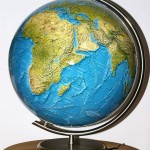
Why We Need More Globes
A recent New York Times Sunday Review opinion piececelebrates the old fashioned globe. Pilot and writer Mark VanHoenacker reminds us of the many advantages of globes. Globes are probably the best way to understand distances across polar regions, to teach earth-sun relationships, and to convey the sense of living on a single, shared planet. Globes […]
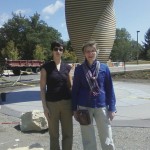
Geography Alumna Designs New Sesquicentennial Plaza
Krisan Osterby-Benson ’79 and Laura Lyndgaard designed the new Sesquicentennial Plaza that connects the chapel with the new West Mall. The design features an amphitheater, outdoor skating rink, two major sculptures, plantings, Kasota stone boulders, and engraved stones commemorating important events in the life of Gustavus Adolphus College. Kris and Laura are with the Minneapolis […]
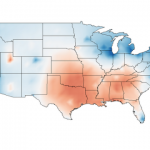
Presidential Elections in Blue and Red, 1920-2008
Instead of a standard county-level choropleth map of election results,David B. Sparks created an isarithmic or contour map of the data. He used the centroids for each county and election results to create a surface. Essentially the height measures the strength of Republican or Democrat support. Then, he interpolated between elections to create a video […]

The Changing Geography of Olympic Medal Winners
The New York Times has created a great information graphic showing the medal winners for each of the modern-era summer Olympics. It is a simple cartogram with proportional circles representing the number of medals each country earned. The color scheme and design are simple and effective. As you scroll across the timeline, you can see […]
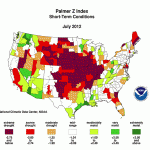
Drought Status as of July 2012
The Palmer short term drought index shows a large swath of extreme drought conditions in the Central United States.
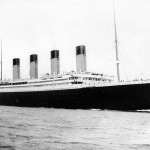
Geography, Class, and the Fate of Passengers on the Titanic
GIS software maker ESRI has created a fabulous series of story maps showing how class and geography intersected to influence a person’s odds of surviving the sinking of the Titanic. First class passengers had a 38% survival rate and were largely from the United States, in particular, New York City. On the other hand, a […]

Gustavus Student Participates in Physical Geography Research Project in Costa Rica
Rachel Oien ’13, a Gustavus environmental studies and geology student, is working on a National Science Foundation Research Experience for Undergraduates in Costa Rica. Rachel’s work is physically demanding, involving rappelling down steep slopes and augering soil samples from the forest floor. Student researchers can take satisfaction in knowing that their efforts are important. The […]
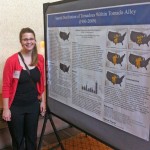
Melissa Wygant Represents Gustavus at Hazards Conference
Melissa Wygant, a recent geography graduate, presented her research at the Natural Hazards Conference in Boulder, Colorado. She presented a poster entitled, “Spatial Distribution of Tornadoes within Tornado Alley” which was a class project for GEG-240: Introduction to Geographic Information Systems. Her analysis showed a northward shift in the density of tornadoes and more frequent […]